Multi-agent creation
Specialized agents mirror a professional design pipeline—from script interpretation and art direction to visual generation and composition.
ETPDesigner automates electronic theater program creation through multi-agent collaboration, producing cohesive posters, backgrounds, and character assets while enabling animation, speech, and real-time character conversation.
Electronic Theater Programs (ETPs) serve as critical promotional media in the performing arts, comprising a multi-page collection of heterogeneous visual assets such as theatrical posters, performance details, and character portraits. However, existing text-to-image paradigms struggle with such complex design tasks due to their inability to comprehend long-context narratives and maintain visual consistency across multiple distinct pages. To address this, we introduce ETPDesigner, a collaborative Multi-Agent framework that directly synthesizes high-quality ETPs from raw dramatic scripts. Emulating a professional design pipeline, our framework orchestrates specialized agents for semantic script analysis, core poster synthesis, functional background generation, and the stratified composition of character assets. Central to ETPDesigner is a global style anchor mechanism that extracts visual priors from the core poster to enforce strict aesthetic uniformity across all generated components. Furthermore, we elevate the ETP from a static publication to an immersive interactive companion. By integrating portrait animation, customized speech synthesis, and persona-grounded Large Language Models (LLMs), our system enables users to engage in real-time, voice-enabled conversations with the generated virtual characters. To rigorously benchmark this task, we construct ETP-Pro, a domain-specific benchmark of professional theater posters and high-quality character portraits. Extensive evaluations demonstrate our method's superiority in producing semantically faithful, aesthetically consistent, and highly interactive program sets.
Specialized agents mirror a professional design pipeline—from script interpretation and art direction to visual generation and composition.
Visual priors extracted from the core poster keep backgrounds, layouts, and character assets coherent across the entire program.
Animation, personalized speech, and persona-grounded LLMs turn each generated role into a vivid, conversational experience.
ETPDesigner first extracts semantic profiles and design constraints from the script. It then employs an iterative synthesis loop, where a VLM-as-a-Judge optimizes the visual generation via a Tree of Thoughts strategy. Finally, global stylistic priors are extracted to guide the generation of consistent backgrounds and decoupled character assets, which are assembled into the final ETP through a constraint-driven programmatic layout engine.
Semantic profiles, character relationships, genre, emotion, and visual constraints are extracted from the dramatic text.
A Tree-of-Thoughts exploration loop and VLM critic iteratively refine the core poster and its global style prior.
Style-guided backgrounds and decoupled character assets are combined through a constraint-driven layout engine.
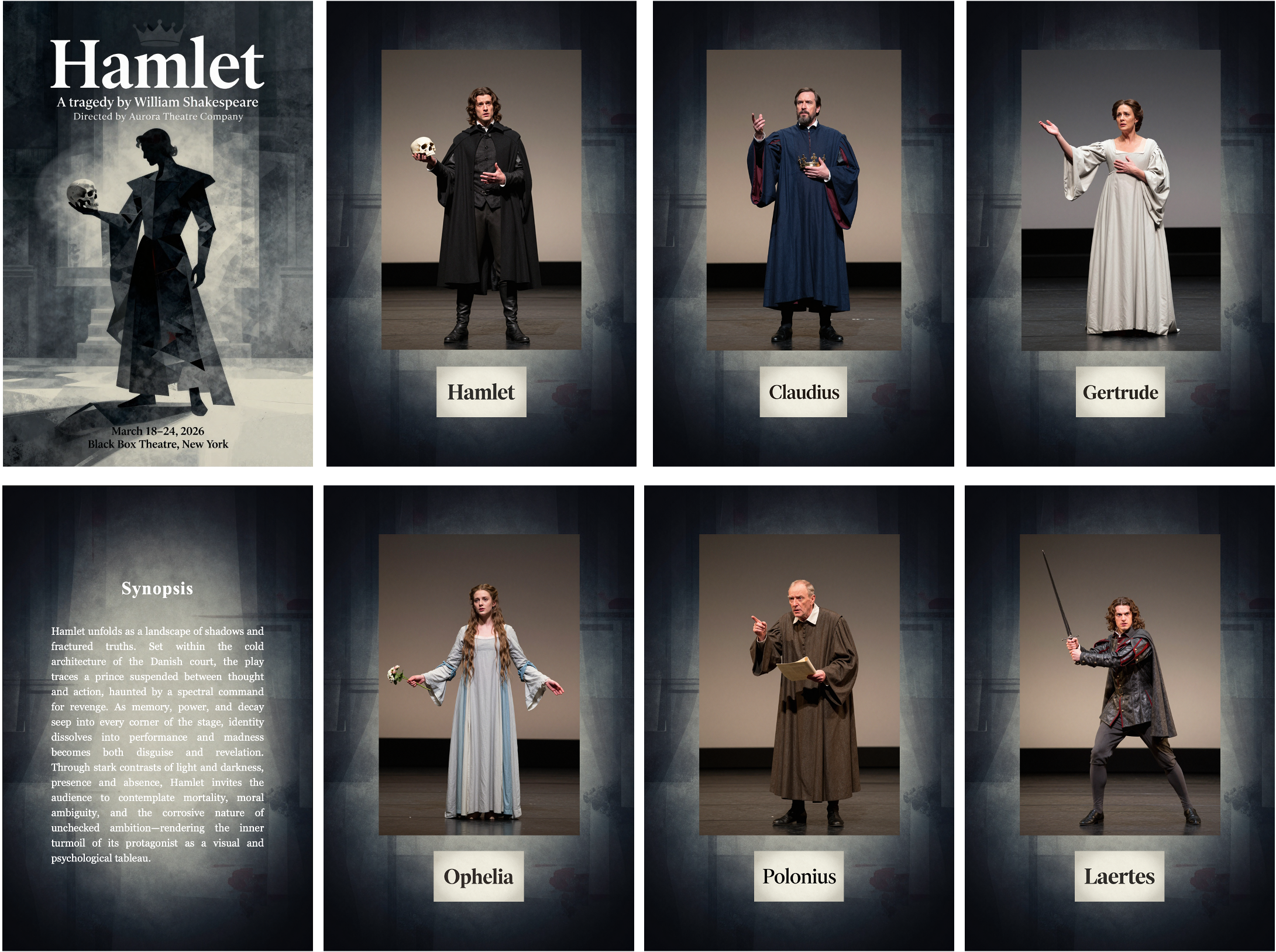
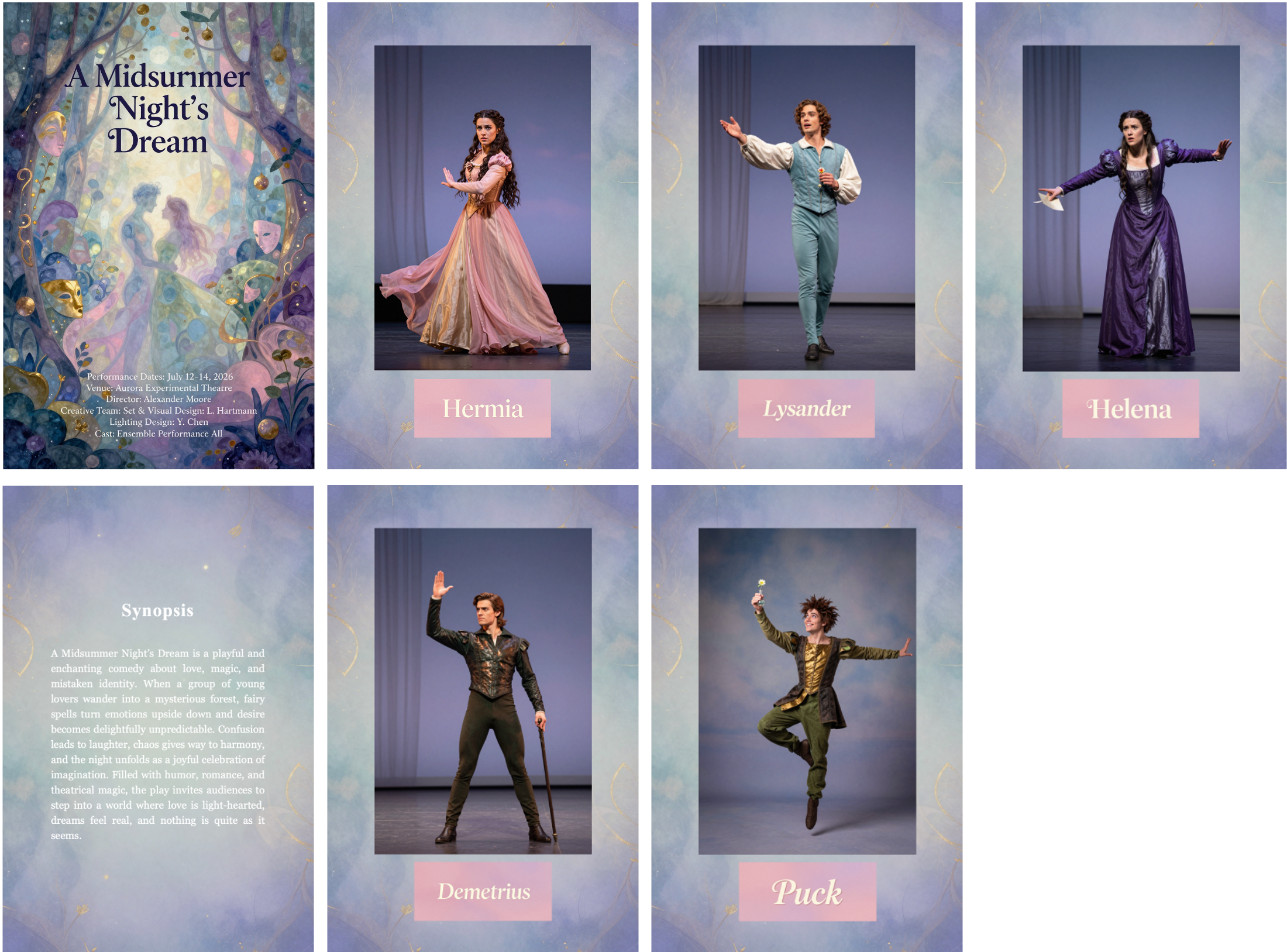
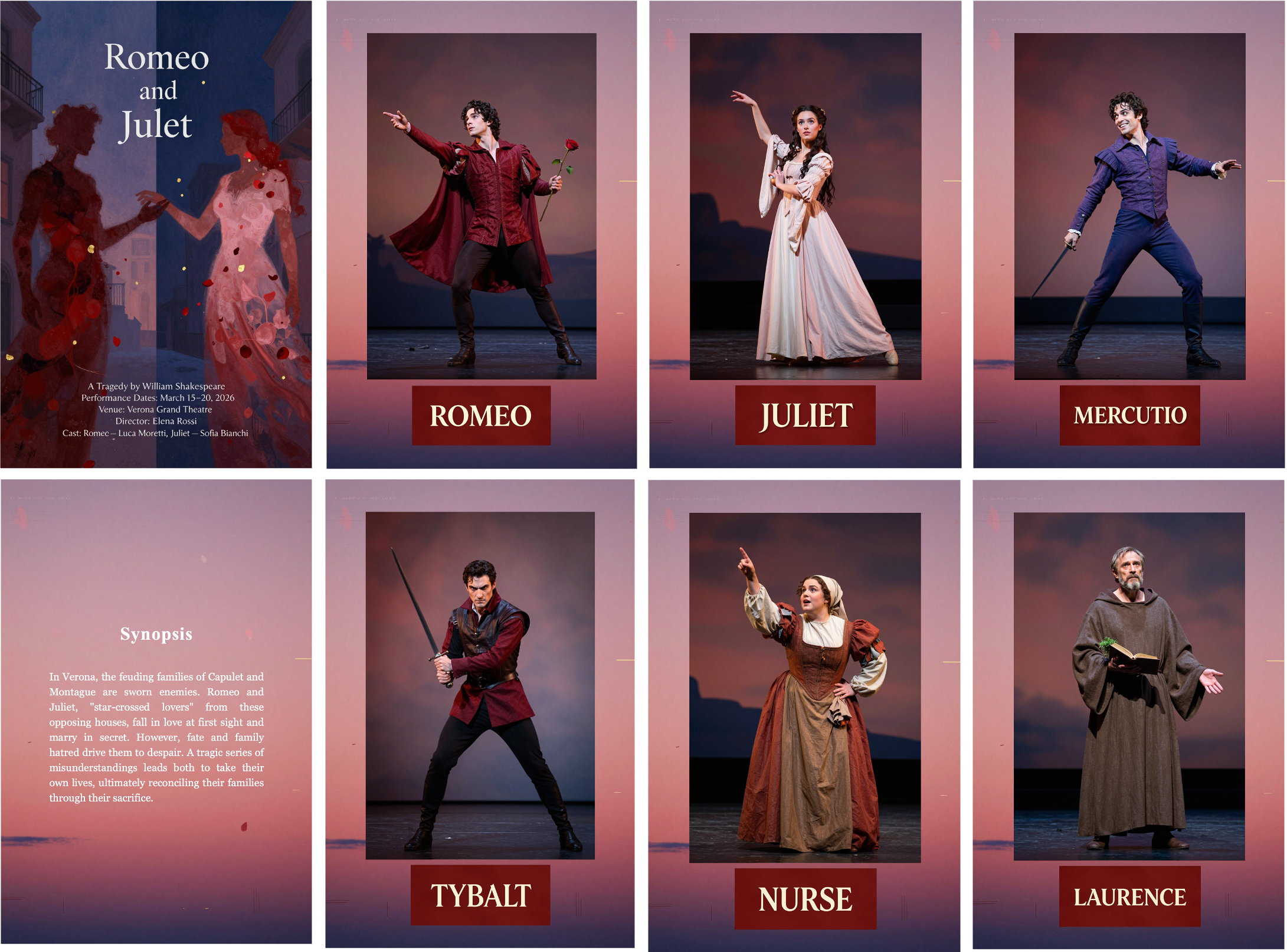
Across tragedy, fantasy, and comedy, ETPDesigner adapts its visual language to each narrative while preserving consistency between the poster, background, and every character page.
A domain-specific benchmark built from professional theater programs and carefully annotated visual assets for evaluating this emerging generation task.
In this work, we introduced ETPDesigner, a multi-agent framework that transforms raw dramatic scripts into cohesive Electronic Theater Programs. By decoupling the generation pipeline into semantic script analysis, global style anchoring, and functional asset synthesis, our approach ensures rigorous theatrical abstraction, structural validity, and cross-component stylistic consistency. Crucially, we elevate the static generation into an interactive multimodal companion by integrating portrait animation, customized speech synthesis, and persona-grounded LLMs, enabling real-time, voice-driven engagement with the generated characters. In addition to these methodological contributions, we contribute ETP-Pro, a domain-specific benchmark curated from professional archives, which serves as a pioneering resource to catalyze future research in automated theatrical publicity and interactive design.